
Saturday, 11 July 2015
We Need More Weird Shows, Even If They’re Not That Great
ICF's oddball Spoils of Babylon didn't seem particularly ripe for a sequel when it aired last year, but here we are: The Spoils Before Dying, a six-episode miniseries, finishes up tonight. It's overwhelmingly ridiculous, but joyfully so. I would have called it the strangest comedy of the week by a long shot — until I saw 7 Days in Hell, HBO's tennis mockumentary starring Andy Samberg. Now that's a weird comedy.
Both, in fact, are very odd, reveling in hyperspecific nonsense, style parodies, appearances by Michael Sheen and a variety of SNL alumni, and a sense that these projects are probably funnier in idea than in execution. What's the polite term for "vanity project"?
Spoils Before Dying is about a jazz musician (Michael Kenneth Williams), his boozy paramour (Kristin Wiig), and his ghost ex (Maya Rudolph). Explaining the plot overemphasizes its significance; mostly it's a lot of silly names and loopy characters. Hell is a faux documentary about a seven-day tennis match between a washed-up Aaron Williams (Andy Samberg, the white adopted brother of the Williams sisters), and a British dope (Kit Harington). Think 30 for 30, but more about its bizarre asides than its subject. Both programs have their virtues, and plenty of very funny pieces, but I'm guessing both were more enjoyable to make than they are to watch.
And yet there's something endearing about both endeavors. Maybe it's their willingness to take premises far, far past logical extremes — how exactly did we get from tennis to a computer-animated news reenactment of Samberg's naked character running from a Swedish prison, with a four-READ MORE -http://www.vulture.com/2015/07/we-need-more-weird-tv-shows.html

Weird westerns that cross the genre border
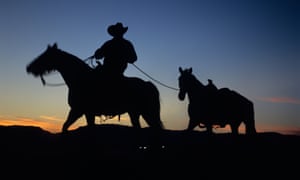 It’s a little-known fact that one of the all-time bestselling writers of westerns lived most of his life in the English market town of Melton Mowbray. JT Edson, who died in 2014, wrote more than 137 novels, most of them westerns, and claimed in all seriousness “never to have even been on a horse”. A former chip shop owner, Edson developed a love of escapist fantasy in his youth, and approached writing westerns just as he later approached writing sci-fi.
The world of the western is about as historically accurate about 19th-century America as the world of the Shire in Lord of the Rings is about pre-industrial England. Both are fantasy worlds, abstracted from reality, crafted by expert fantasists. The pre-eminent western author, Louis L’Amour, loved the mythology so deeply that he began to write novels as a way of escaping into it. Like sci-fi and fantasy authors, writers of westerns, even when their sales stretch into millions, remain at the margins of mainstream culture. So it seems almost inevitable that over time the western and the fantasy have cross-bred.
Stephen King, the master of rejuvenating pulp plotlines for today’s reader, can make a strong claim to owning the weird western as well. The Dark Tower series, which now stands at eight volumes, is the story of gunslinger Roland Deschain -READ MORE -http://www.theguardian.com/books/booksblog/2015/jul/10/weird-westerns-genre-border-fantasy
Eight weird urban sports to try this summer
Rollerskiing
The last time I went cross-country skiing, it was along the snowy trails of St Moritz, skirting a frozen lake. Now I can say I’ve been skiing on flat tarmac in a London park. In June. Needless to say, there was no snow.
I was rollerskiing – an alternative to cross-country skiing that began as a summer training technique in the 1950s, and is now a thriving sport in its own right. It involves short skis, about half a metre long with a small wheel at each end, plus ski poles. The experts at the London Cross-Country Ski Club recommend that beginners have five lessons to build confidence, technique and stamina. I was trying to master the basics in a two-hour crash course – hopefully without too much crashing involved.
Falling over on skis is never fun, but at least on snow you have a relatively soft landing. Tarmac, on the other hand, hurts. This made me tense, wobbly and slow; while the other two beginners in my class immediately zoomed off, I barely moved. On the plus side, I had plenty of time to concentrate on the correct technique.
We shuffled about on grass to get the feel of the skis, then moved on to a path to practise “double poling” (keeping the skis parallel and using the poles to propel yourself along), “skating” (going from side to side, like ice-skating) and “classic” (a smooth forwards stride). Having watched Alison, my instructor, fly along skater-style with the grace of a gazelle, I could certainly see why the more -READ MORE -http://www.theguardian.com/lifeandstyle/2015/jul/11/urban-weird-sports-summer-rollerskiing
Saturday, 4 July 2015
See the weird, trippy results of Google's DeepDream experiment
Google has been showing off the results of an artificial intelligence experiment, where photos were interpreted and edited by what the firm calls its ‘neutral network’.
It uses software called DeepDream, which has been coded to recognise faces and other patterns in images. Once it thinks it has identified a pattern, the software edits the image slightly to make it look more like that pattern, and then repeats the process across the rest of the image.
The results, as Google showed, turned run-of-the-mill photos into strange dream-like scenery and panoramas – mostly because where the software thought it had found a pattern – such as a face or building – it had morphed a scene to look like the pattern.
Trees became dogs, and landscapes had sci-fi towns and villages added to them. It all got very weird, very quickly.READ MORE -http://home.bt.com/tech-gadgets/tech-news/see-the-weird-trippy-results-of-googles-deepdream-experiment-11363990198995
Saturday, 27 June 2015
Partick Thistle's monobrowed mutant sun god brings new evil into the weird world of the mascot
It will have to go down as a PR open goal which was skewed horribly wide. Sunday, 21 June, 2015. Stonehenge. The air is alive with bongos and body odour. From somewhere in the distance, perhaps the car park, comes the lilting sound of a social anthropology undergraduate and virgin squeezing a three-note melody through a flute made of tree bark. The sun’s first rays settle on the wrong side of the A303, casting their sacred shadow upon the stone megaliths of Salisbury Plain and its annual dreary army of druggies, druids and dropouts.
Then, right there in that instant, was the moment for Partick Thistle to release their new mascot upon the earth, his eyes blank, arms outstretched, nose askew, angrily somnambulating out of the dawn horizon, this jagged demi-human hemisphere of solar terror.
Instead, it came 24 hours later in the form of a photo op at Firhill Stadium on the north side of Glasgow, complete with the compulsorily twee Twitter account and a press release informing -READ MORE-http://www.independent.co.uk/sport/football/news-and-comment/partick-thistles-monobrowed-mutant-sun-god-brings-new-evil-into-the-weird-world-of-the-mascot-10349154.html
Saturday, 20 June 2015
Google’s image recognising robots turned on themselves, making weird dreams that could show why humans are creative
Computers have dreams, according to Google — and they’re often highly trippy, strange ones of dog-fishes and bananas.
Google’s highly-powered, clever computers are normally used for image recognition — a technology that requires computers to think like humans, learning what things look like. But the company set them loose identifying small, subtle things, skewing the images to show a knight made of dogs or clouds that resemble a “pig snail”.
The search giant is just one of many companies who are working on artificial neural networks, which use highly-developed mathematical methods to simulate the way that human’s brains think. But by turning those computers upside down, they throw out the strange images.read more -http://www.independent.co.uk/life-style/gadgets-and-tech/news/googles-image-recognising-robots-turned-on-themselves-making-weird-dreams-that-could-show-why-humans-are-creative-10330996.html
Saturday, 13 June 2015
Frisbees, sandals and picnics: weird things banned by health and safety
You might not think of a postman as a particularly dangerous job. The odd vicious dog might be the biggest risk they might have to contend with.
But in Berkshire a worried postman is delaying delivery to a house on a country road because he is too afraid to cross - and the Royal Mail are backing him up.
The retired occupants say they're waiting until mid-afternoon to receive their post, when it used to come in the morning.
Health and Safety has saved thousands of lives - but it does occasionally lead to some pretty odd situations. Here are a few of the strangest Health and Safety incidents.
Watch out for the cobbles
The Royal Mail has form when it comes to slightly barmy health and safety. When residents in Bideford, Devon, complained that they weren't receiving their post, they argued it wasn't safe for postmen to travel down the cobbled street.-READ MORE-http://www.telegraph.co.uk/news/uknews/law-and-order/11670553/Frisbees-sandals-and-picnics-weird-things-banned-by-health-and-safety.html
Subscribe to:
Posts (Atom)